Most Common Issues in Commercial Kitchens
Bu içeriği yapay zeka ile özetle
When a piece of equipment goes down during a busy service, it is more than a technical problem. It directly affects service speed, product safety, hygiene standards and the day’s work plan. In equipment that runs on water, heat, oil, gas and refrigeration cycles, even a small maintenance oversight can quickly turn into a loss of performance.
When assessing failure risk, it is better not to treat all equipment alike, but to prioritize the machines that run continuously and carry the heaviest technical load. When maintenance planning, capacity selection and technical service access are set up properly from the start, equipment-related downtime becomes far easier to manage.
Which Equipment Carries the Highest Risk of Failure?
Failure risk should be judged by how intensively a machine runs and the conditions it operates in. A refrigerator running all day, a dishwasher fed with hard water, a fryer working at high temperatures and an ice machine that cycles constantly each create maintenance needs for different reasons.
The risk is most pronounced in these groups: refrigeration equipment, dishwashers, ice machines, fryers, ovens and cooking lines. When choosing these products, usage intensity, their role in the kitchen and their maintenance requirements should be considered together.
Common Factors That Increase Failure Risk
Equipment types differ, but similar operating habits sit behind many failures. Knowing them is the first step toward building a sound maintenance plan:
- Operating equipment beyond its rated capacity
- Limiting daily cleaning to surface wiping
- Not monitoring water hardness and limescale
- Allowing grease, sediment and food residue to build up
- Neglecting checks on filters, fans, gaskets, pumps, heating elements and burners
- Using the wrong detergent, rinse aid or cleaning chemical
- Problems in the electrical, gas and water infrastructure
- Staff using the equipment differently from shift to shift
- Leaving periodic maintenance until after a failure
- Delaying a service call until the problem has grown
Refrigeration Equipment: Compressor, Fan and Gasket Failures
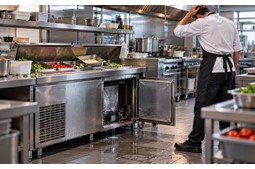
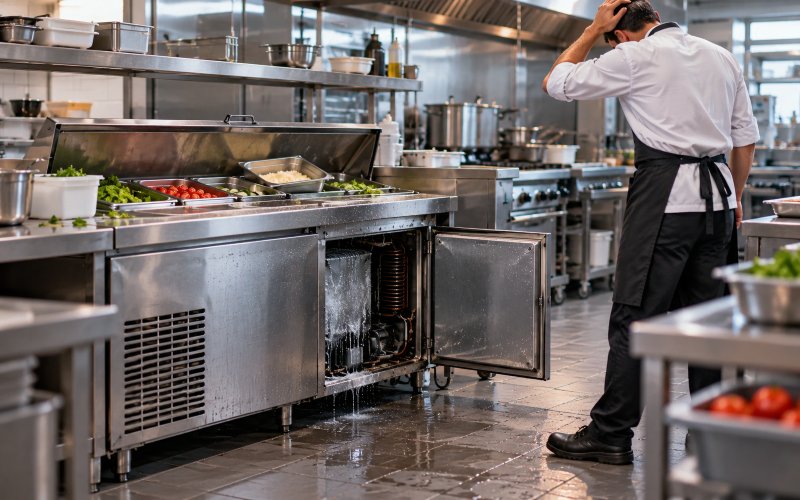
Industrial refrigerators, deep freezers, prep-table coolers and walk-in cold rooms are among the riskiest groups because they run for most of the day. The compressor, fan, condenser, sensor and door gasket are in constant use.
The most common problems are:
- The compressor running longer than it should
- A door gasket leaking air
- The condenser clogged with dust and grease
- Fans turning inefficiently because of ice, dirt or poor product placement
- Fluctuating internal temperature
- Cooling loss from frequent door opening
A failure is not always obvious from the unit stopping completely. Frost inside, standing water, a louder motor, condensation around the door or fluctuating product temperatures are all early warnings. When a gasket leaks air, the compressor runs longer, which raises energy use and shortens the life of the equipment.
Regular condenser cleaning, correct product placement and gasket checks should never be neglected. Failures in this group can lead to product loss and food safety risks on top of the equipment cost.
Industrial Dishwashers: Limescale, Pump and Drain Problems
Because they cycle on and off all day, a lapse in maintenance quickly shows up as lost performance. Common problems are:
- Dishes coming out spotted or greasy
- Cloudy glasses and water marks
- The machine not filling with water or not draining
- The heating element failing to reach adequate temperature because of limescale
- Reduced pump performance
- Clogged filters and spray arms
- Odor or residue buildup inside the machine
When a dishwasher doesn’t wash well, the cause is usually not an inadequate machine but filter cleanliness, water pressure, chemical dosing or limescale. In kitchens with hard water, the heating element and pump work under greater strain. This lowers wash quality and increases the need for service calls.
Daily filter cleaning, spray arm checks, correct detergent and rinse aid settings and water hardness monitoring directly affect performance. When the dish line stops during a rush, the whole service flow slows down.
Ice Machines: Limescale, Water Filter and Sensor Problems
In cafés, bars, hotels and restaurants with heavy beverage service, ice machines are critical equipment. They depend directly on water quality, filter condition, the cooling system and sensors.
Common problems are:
- Slower ice production
- Poorer ice quality or cloudy ice
- A clogged water filter
- Limescale buildup
- Pump or drain problems
- Sensors reading incorrectly
- Odor or hygiene problems in the internal bin
Water quality is one of the most decisive factors. Limescale strains both the water line and the internal mechanism. If filter replacement is late, production capacity drops and the machine cycles on and off more often.
Ice machines are less conspicuous than main cooking equipment, but in a busy beverage operation even a small fault disrupts the flow. The water filter, drain line and internal cleanliness should be checked regularly.
Fryers: Oil Quality, Thermostat and Heating Element Problems
Fryers work at high temperatures with oil, which puts them among the higher-risk groups. Leaving oil unchanged for too long, skipping filtration and neglecting tank cleaning all stress components faster.
Common problems are:
- Oil taking too long to reach the set temperature
- Longer frying times
- Thermostat drift
- Residue buildup around the heating element or burner
- Overheating
- The safety thermal cutout tripping
- A clogged drain line
Oil sediment and carbonized residue impair heat transfer. Food cooks more slowly, oil absorption rises and service speed drops. Daily oil filtration, tank cleaning and temperature checks directly determine equipment life.
It is wrong to assume a failure always comes from an electronic or mechanical part. For many fryer problems, the first trigger is poor oil management.
Ovens and Combi Ovens: Heat, Fan and Sensor Failures
Ovens and combi ovens operate under high heat and directly determine product quality. The same recipe giving different results, longer cooking times or one side of the tray overcooking usually point to heat distribution.
Common causes are:
- Reduced heating element or burner performance
- A strained fan motor
- Thermostat or temperature sensor faults
- Heat escaping through the door gasket
- Limescale or sediment in the steam system
- Electronic control panel failures
Because combi ovens also use steam, their maintenance needs are more sensitive than those of conventional ovens. Limescale in the steam channels can affect cooking balance and humidity control.
It is important to distinguish user error from technical failure. A fan, heating element or sensor problem requires technical intervention. Trays placed so that they block airflow, on the other hand, are mostly a matter of habit. If this distinction isn’t made, real faults are noticed late.
Ranges, Grills and Cooking Lines: Burner and Ignition Problems
Gas ranges, grills and cooking lines are used continuously during busy service hours. Failures are usually related to the burner, ignition system, gas line, thermostat or the cleaning routine.
Warning signs to watch for:
- A change in flame color
- Difficult ignition
- Uneven heat distribution
- The smell of gas
- Clogged burner ports
- Excessive soot
- Reduced heating element performance on electric models
With gas equipment, safety always comes before performance. Staff can handle daily cleaning and visual checks, but the gas connection, safety system and burner adjustment should be left to technical service. If there is a change in flame color, a smell of gas or irregular combustion, the equipment should not be used.
Grease and food residue on burner ports cause unstable flames and reduced cooking performance. Regular cleaning is essential for both hygiene and combustion efficiency.
How Should a Maintenance Plan Be Set Up to Reduce Failure Risk?
Maintenance should not come onto the agenda only after the equipment has stopped completely. For a sound plan, how often each machine is used, where it operates and how much its failure would affect kitchen flow should be assessed together.
A basic maintenance plan should include these steps:
- Daily: Filter, surface and residue cleaning
- Weekly: Gasket, fan, drain and spray checks
- Monthly: Review of electrical, gas and water connections
- Ongoing: Monitoring of limescale, grease and sediment buildup
- Staff: Briefing on equipment operating instructions
- At purchase: Evaluating technical service and spare parts access
Not all equipment needs to be checked equally often. Refrigerators running all day, dishwashers using hard water, fryers working at high heat and ice machines cycling constantly each have different maintenance priorities. Making this distinction extends equipment life and reduces unnecessary maintenance costs.
What Should Be Considered So Failures Don’t Disrupt Service?
The cost of a failure is not limited to the repair bill. Waiting for service, spoiled product, disrupted staff schedules, delayed orders and the length of the service call all add to the total. That is why, at purchase, the short-term price advantage should be weighed against service life, ease of maintenance and spare parts continuity.
When choosing equipment, consider:
- Capacity suited to daily production or service volume
- A technical build suited to heavy use
- Easy-to-clean surfaces and accessible parts
- Energy consumption and operating efficiency
- Compatibility with water, gas and electrical infrastructure
- Spare parts continuity
- Technical service access
When cooking, washing, refrigeration and prep areas are planned together, failure risk drops and the output from the equipment becomes more consistent. Working with suppliers such as S2000 Mutfak that offer different equipment groups in one place makes this planning, and the service process afterward, easier.
Businesses planning a new installation, a renovation or a capacity increase should analyze their equipment needs together with service intensity, staff flow and maintenance processes.
Frequently Asked Questions
Which equipment fails most often in industrial kitchens?
Generally refrigeration equipment, industrial dishwashers, ice machines, fryers, ovens and cooking lines. These machines run on water, heat, oil, gas or refrigeration cycles, so they are affected more quickly by maintenance neglect.
How can a failure in refrigeration equipment be detected early?
Temperature fluctuations, frost buildup, standing water, a louder motor or air leaking from the door gasket are early warnings. A compressor running longer than normal also shows the unit is under strain.
Why might an industrial dishwasher not wash well?
Possible causes are a clogged filter, sediment in the spray arms, low water pressure, incorrect detergent or rinse aid dosing, or limescale. If there are spots on glasses, a greasy film on plates or odor inside the machine, cleaning and water hardness should be checked first.
Why does an ice machine produce no ice or produce it slowly?
A clogged water filter, limescale buildup, drain line problems, a sensor fault or reduced performance in the cooling system can slow ice production. Water quality and filter maintenance should be kept up regularly.
What increases the risk of failure most in fryers?
Leaving oil unchanged for too long, not filtering regularly and neglecting tank cleaning. Oil sediment builds up around the heating element or burner and disrupts heat transfer.