Everything You Have To Know About About Dry Aged Cabinets
Bu içeriği yapay zeka ile özetle
What is Dry Aged? What are Dry Aged Meat Refrigerators Used For?
The Emergence of Dry Aged Refrigerator Models
The concept of "dry aged," frequently encountered in many premium establishments from steakhouses to gourmet restaurants in recent years, is considered one of the most prestigious maturation methods in the meat world. Although it has become popular again with modern gastronomic trends, dry aging is actually a professional version of a traditional meat aging technique that has been practiced for centuries, developed with today's technology.
The term "dry aged" is of English origin and can be translated into Turkish as "dry resting" or "dry maturation." Although this method, Dry Aged, seems like a modern trend, its origins go back to the late 19th century. Especially in the meat industry that developed in Europe and the United States between 1870 and 1900, it was realized that carcass meats were kept in controlled environments with the widespread use of refrigeration technologies. In those days, since vacuum packaging systems didn't exist, meats were naturally aged in dry environments, and this process allowed the meat's flavor to intensify.
In the early 20th century, butchers and meat traders in meat trading centers like Chicago, New York, and London began consciously applying this method, observing that meat aged under specific temperature and humidity conditions became softer and more aromatic. Particularly with the rise of the famous steakhouse culture in America, dry-aged meats became a premium product category. Established restaurants like Peter Luger Steak House (1887) in New York gained fame for their dry-aged meats, contributing to the method's worldwide recognition.
Although "wet aging" became widespread in the 1960s and 1970s with the development of vacuum packaging technology, many gourmet chefs and meat experts continued this tradition due to the intense aroma and superior flavor offered by the dry-aged technique. Today, the dry-aged method is considered one of the most prestigious meat aging techniques preferred by high-quality steakhouse restaurants, butchers, and premium meat producers. It has become widespread globally. In the days before the development of refrigeration technologies, meats were aged in cool cellars with natural airflow. During this process, the outer surface of the meat dried while the inner part became more intensely flavored and tender. Over time, this traditional method has been improved with professional systems; modern dry-aged cabinets have emerged, where temperature, humidity, and air circulation are controlled. Today, the dry-aged method is considered one of the most valuable techniques in premium meat production.
The dry-aged method is a controlled maturation process aimed not only at preserving the meat but also at deepening its aroma, softening its texture, and intensifying its flavor. Thanks to this process, carried out under appropriate temperature, humidity, and air circulation, the meat acquires a unique, strong aroma and an unparalleled texture. Therefore, dry-aged meats offer a much more premium and special experience compared to classic meat products.
However, standard refrigeration is insufficient for this process to be carried out in a healthy, safe, and professional manner. The success of the dry aging process depends on the flawless management of temperature balance, humidity control, airflow, and hygiene conditions. This is where dry aging meat cabinets come into play.
Specially designed dry aging cabinets allow the meat to mature under controlled conditions, enhancing both flavor and safety. Offering a professional solution for restaurants, butcher shops, hotels, and meat-related businesses, these systems also contribute to the aesthetic display of products.
In this article, we will address many important topics, from the origins of the dry aging concept to its working system. We will examine the following topics in detail:
Contents
* Origin of the Term Dry Aged
* Why Does Meat Become More Delicious the Longer It Ages?
* What is a Dry Aging Cabinet?
* What is the Purpose of a Dry Aging Cabinet?
* What is the Difference Between a Dry Aging Cabinet and a Normal Refrigerator?
* How Do Dry Aging Cabinets Work?
* How Long Does the Dry Aging Process Take?
* Who Needs Dry Aging Cabinets?
What is Dry Aging and How Did It Originate?
Dry aging is not a new discovery in the modern gastronomic world; it's a traditional meat maturation technique dating back centuries. In the days before refrigeration technologies were developed, butchers and meat producers stored beef in cool cellars or stone warehouses with natural airflow. Over time, it was realized that meat aged under specific conditions became softer, more aromatic, and had a more intense flavor.
It became professionalized, especially with the development of steakhouse culture. Premium meat restaurants and butchers began using special dry aging cabinets for controlled maturation of meat. Today, dry aging technology is implemented with advanced systems that provide temperature control, humidity balance, and air circulation.
Today, dry-aged meat is considered one of the most valuable products in the premium meat category worldwide. Dry aging cabinets have become an important part of professional kitchen equipment, especially for steakhouse restaurants, boutique butchers, and gourmet kitchens.
⸻
Why Does Meat Get Tastier the Longer It Ages?
The dry aging process is based on biochemical changes that occur in the natural structure of the meat. After slaughter, the natural enzymes in the meat continue to work and begin to break down muscle fibers over time. Thanks to this process, the meat becomes both softer and its aroma intensifies.
One of the most important reasons for the increased flavor of dry-aged meat is moisture loss. As the meat ages in a controlled environment, it loses some of its water. This makes the meat's aroma more concentrated and results in a much more intense flavor.
At the same time, thanks to changes in protein and fat structure, dry-aged meats develop:
* Stronger aroma
* Nutty and buttery flavors
* Softer texture
* Intense meat flavor
High-quality meats such as ribeye, T-bone, and veal loin are preferred for dry aging. This is because meats with a high fat content yield more successful results in the long-term maturation process.
⸻
What is a Dry Aging Cabinet?
A dry aging cabinet; Dry aging cabinets are professional cooling systems specifically designed for the controlled maturation of meat. Unlike standard refrigerators, dry aging cabinets precisely manage temperature, humidity, and air circulation.
The main purpose of these cabinets is:
* Safe aging of the meat
* Controlled drying
* Prevention of bacterial growth
* Enhancement of meat flavor
* Creation of a professional dry aging process.
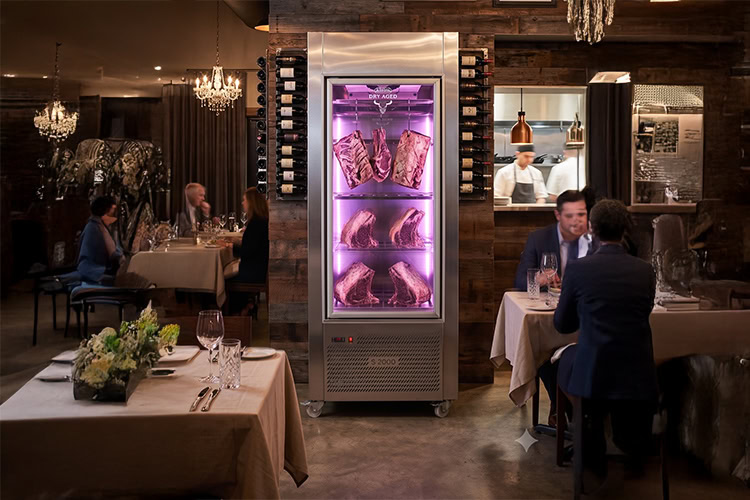
Dry aging cabinets are generally produced with glass doors and stylish designs. This allows restaurants and steakhouses to both preserve their meat and provide a visually appealing presentation advantage to customers.
Thanks to the UV filtration systems, activated carbon filters, and humidity control technologies used in professional dry aging cabinets, meats are aged safely under hygienic conditions.
What is a Dry Aging Cabinet Used For?
Dry aging cabinets are the most critical tool in transforming ordinary beef into a luxury gourmet product by allowing meat to mature in a controlled manner. Dry aging is impossible without these cabinets. The importance of dry aging cabinets, both in gastronomy and business, is as follows:
1. Prevents Spoilage, Ensures Controlled Aging: Under normal conditions, meat left out in the open or placed in an ordinary refrigerator quickly spoils and becomes toxic due to the growth of harmful bacteria. A dry aging cabinet, however, completely stops bacterial growth. It allows the beneficial enzymes within the meat to digest and tenderize it on their own, preventing spoilage. In other words, it doesn't spoil the meat; it matures it in a controlled manner.
2. Provides Perfect Microclimate Stability: During the meat aging process, even a 0.1-degree fluctuation in temperature or a 1% fluctuation in humidity can cause all the meat to be wasted. The heat and humidity balance inside standard commercial or household refrigerators is disrupted every time the door is opened. Dry aging cabinets are completely isolated from the outside environment; even if the door is opened, it returns to the ideal temperature balance of 0°C - +2°C and 75% - 85% humidity within seconds.
3. Provides Maximum Food Safety and Sterilization: These cabinets contain industrial UV-C (ultraviolet) light systems and special activated carbon filters. As the air constantly circulates inside the cabinet, it passes through these filters and UV rays. In this way, all mold, fungi and harmful microbes in the air are killed. The meat rests safely in a completely sterile atmosphere.
4. Offers High Prestige and Marketing Power for Businesses: For restaurants and qualified butchers, dry aging cabinets are also a great showcase. The special glass designs and the aesthetic appearance of Himalayan salt inside directly show customers the expertise and quality of the business in meat. It elevates the value of the meats on the menu and the prestige of the business to an elite level. 5. Creates Economic Added Value: Although meat undergoes significant mass loss (waste) as a result of the dry aging process, the value and flavor of the remaining meat increase exponentially. It transforms ordinary meat into a premium, high-priced gourmet product, providing businesses with much higher profit margins.
The Dry Aging Process
There are significant differences between dry aging cabinets and standard refrigerators. Home or standard commercial refrigerators are designed solely for storing products. However, dry aging cabinets allow for controlled maturation of the meat.
During the dry aging process, time directly determines the flavor and texture of the meat. As the process lengthens, the mass of the meat decreases while its aroma and tenderness increase. The daily changes and numerical data are as follows:
7 - 14 Days (First Stage): The collagen structure in the meat begins to break down. Signs of tenderization appear, but there is no significant change in flavor. The meat is still bright red because it has not yet lost water. 14-21 Days (Development Stage): The meat loses approximately 5% to 10% of its total weight through water loss (evaporation). The color of the meat darkens, and its flavor begins to become more pronounced.
28 Days (Gold Standard): This is the most preferred ideal time in the industry. The meat has lost approximately 15% to 20% of its weight. Enzymes have completely tenderized the meat, giving it a "melt-in-your-mouth" consistency. Nutty and buttery aromas are most clearly revealed during this period.
45-60 Days (Gourmet Stage): The meat loses 25% to 30% of its weight. Very intense, almost aged cheese (blue cheese) or charcuterie-like sharp aromas develop. 90+ Days (Extreme Stage): Applied only to special meats with a very high marbling (fat) rate. The loss rate can reach 40%. A very sharp and dominant taste profile is formed. However, the long meat drying process requires professional equipment. Therefore, high-quality dry-aging cabinets are of great importance for the safe progress of the process.
Himalayan Salt in Dry Aging Cabinets
In these processes, pink Himalayan salt blocks placed at the bottom or back of the cabinets are not just a visual decoration, but a chemical shield that determines the success of the process:
Natural Humidity Regulator (Hygroscopic Effect): Salt blocks draw excess moisture from the environment onto themselves. When the humidity level inside the cabinet decreases, they release this moisture back. Thus, it ensures that the humidity level remains perfectly constant between 75% and 85%.
Natural Antibacterial and Air Sterilization: Salt has a lethal effect on microorganisms in the environment. By eliminating harmful bacteria suspended in the air that can cause the meat to rot, it guarantees that the meat will only "age" without spoiling.
Flavor Profile and Ionization: Salt blocks release negative ions into the cabinet. These ions adhere to the surface of the meat through air circulation, contributing to a cleaner, smoother, and richer development of the dry-aging aroma. Thanks to professional dry-aging cabinets:
* Meat loses water in a controlled manner
* Flavor intensifies
* Muscle fibers soften
* A special aroma develops
* Hygienic storage is ensured
How Do Dry Aged Refrigerators Work? What's the Difference from a Normal Refrigerator?
The Meeting of Precision Engineering and Premium Display: Dry Aged Refrigerators. Unlike ordinary storage refrigerators, dry aged refrigerators are premium showcases with advanced technology that preserve and transform meats. While ordinary refrigerators dry out moisture by blowing aggressive air and cause the meat to rot from the inside; dry aged refrigerators maintain a constant humidity of 75-85% and a temperature of 0°C/+2°C at the micro level thanks to their hybrid cooling system and ultrasonic humidifiers. While normal refrigerators only slow down bacterial growth and cause odor, these devices instantly eliminate all harmful microorganisms in the air with 254 nm UV-C sterilization lights and activated carbon filters, ensuring safe maturation at the molecular level. While ordinary double-glazed windows oxidize and sour the fat tissue of the meat with external light; The special glass insulation systems used in these professional dry-aged cabinets, featuring low-e coating, argon gas, and UV filters, completely isolate the delicate interior climate from the outside world. All this engineering also translates into a captivating marketing force for butchers and restaurants. Equipped with amber LED lights and backlit pink Himalayan salt walls, these four-sided glass panoramic dry-aged cabinets add a premium steakhouse aesthetic to businesses, offering customers a visual feast. Who Needs Dry Aged Cabinets?
Dry-aged cabinets are indispensable professional equipment, especially for businesses that serve premium meats. Businesses that want to both improve flavor quality and gain a visual presentation advantage invest in dry-aged systems.
Dry-aged cabinets are most commonly used in:
Steakhouse Restaurants
Professional dry-aged cabinets provide a great advantage for restaurants that want to offer premium dry-aged steaks to their customers.
Butchers
Boutique butchers can increase product value and customer interest with dry-aged meat products.
Hotels and Professional Kitchens
Luxury hotels and gourmet kitchens use dry-aged systems for their special meat menus.
Meat Producers and Delicatessens
Dry-aged display cabinets set the quality standard for businesses producing premium meat.
Today, dry-aged meat display cabinets are not just a storage system; they also represent quality, prestige, and professional presentation.
Dry Aged Display Cabinet Prices
The prices of dry-aged display cabinets vary widely depending on the capacity of the appliance, its technological equipment, and design features. Custom-made, double-door, or luxury models with large display glass require high-budget investments, while standard single-door models offer much more economical and budget-friendly solutions. Moreover, these standard models provide businesses with great flexibility thanks to their modular and optimized internal structures. Multiple standard appliances can be added side-by-side as needed, increasing the number of doors indefinitely; thus, as your business grows, you can expand your cabinet capacity without limit.
Dry Aged Refrigerator Models
Dry aged refrigerators are produced in different model options according to both the technological equipment that determines the quality of meat maturation and the physical conditions of the businesses. In this category, standard models, which appeal to every budget and offer unlimited door options by adding them side-by-side thanks to their modular structure, provide a much more suitable and economical solution for businesses that want to avoid high costs. For elite restaurants and gourmet butchers who want to maximize visual appeal and aesthetics, there are panoramic models with glass on all sides that allow the meat to be viewed from every angle. Whether you choose a budget-friendly standard model or a display model with glass on all four sides; all these options are designed to mature your meats in the safest microclimates.
If you want to purchase a long-lasting, high-quality, and reliable Dry Aged Refrigerator for your business, you can contact us.